'True Random Number Generators'
Random Number Generators
It is surprising to see the number of applications large lists/streams of random
numbers is used for in modern science and engineering. Even before the advent of
computers tables of random numbers have been used for randomized trials in
statistics
Randomness from Nature
To generate true random numbers we can turn to nature. Physically measuring
thermal noise, electron emission or even coin flips are better random
number generators than algorithms.
This Numberphile video
talks about using the number of electrons emitted out of radioactive decay
in a given time as a measure of random number.
Gaussian to Uniform
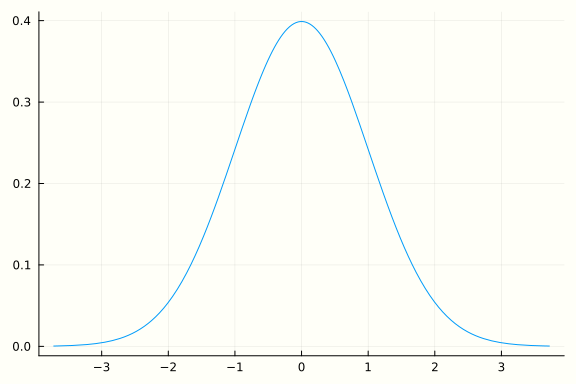
Now we have a way to sample from nature's normal distribution. We assume that it is a standard normal distribution, so the mean \(\mu = 0\) and variance \(\sigma^2 = 1\). Let \(Z \sim \mathcal{N}(0, 1)\) (If we have a non-standard normal random variable \(X \sim \mathcal{N}(\mu, \sigma^2)\) then \(Z = \frac{X - \mu}{\sigma}\) gives us a standard normal).
We know that the Probability Density Function for normal distribution is
The definition of the Cummulative Density Function is
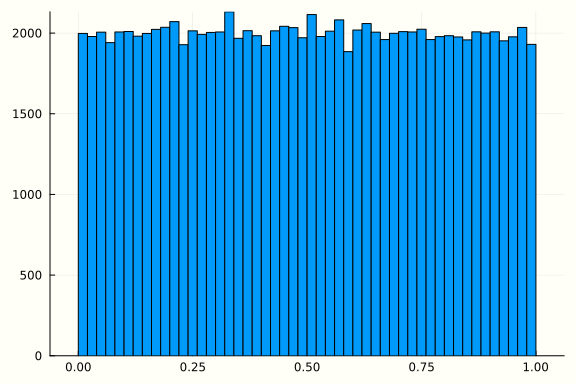
Consider $ \mathbb{P}(F(Z) \le x) $.
$$ \mathbb{P}(F(Z) \le x) = \mathbb{P}(Z \le F^{-1}(x)) = F(F^{-1}(x)) = x $$
We can do this in Julia as follows:
using Distributions, StatsPlots
dist = Normal(0, 1)
plot(dist)
z = rand(dist, 100000)
x = cdf.(dist, z)
histogram(x, leg=false)
using Random
mutable struct MidSquareRNG <: AbstractRNG
    seed::UInt128
    max_len::UInt32
    max_val::UInt128
    lo_idx::UInt32
    hi_idx::UInt32
    function MidSquareRNG(seed, max_len)
        max_val = parse(UInt128, lpad("", max_len, "9"))
        lo_idx = convert(UInt32, floor(max_len/2))+1
        hi_idx = lo_idx + max_len - 1
        new(seed, max_len, max_val, lo_idx, hi_idx)
    end
end

function generate(r::MidSquareRNG, size)
    values = Vector{Float64}()
    for i=1:size
        push!(values, r.seed/r.max_val)
        next_str = lpad(string(r.seed^2), 2*r.max_len, "0")
        r.seed = parse(UInt128, next_str[r.lo_idx:r.hi_idx])
    end
    values
end
generate (generic function with 1 method)
using Plots, Colors
function visualize(r, n)
    A = reshape(generate(r, n*n), n, n) #.> 0.5
    plot(Gray.(A), axis=nothing, size=(300,300))
end

r = MidSquareRNG(111112341, 10)

r = MidSquareRNG(10000112120, 10)
r = MidSquareRNG(1311111111, 10)
r = MidSquareRNG(100120, 10)
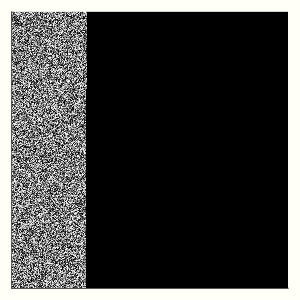
visualize(r, 550)
[1] Eckhardt, Roger, Stan Ulam, and Jon Von Neumann. "the Monte Carlo method." Los Alamos Science 15 (1987): 131.
[2] Randomess and Pseudorandomness, BBC In Our Time https://www.bbc.co.uk/programmes/b00x9xjb